The Etna Viewpoint

The Etna viewpoint

The viewpoint is situated at around 2600 metres, along the south-western flank of the Valle del Bove. It can be reached easily even by those with no experience in long trekking: in fact, the funicular from Rifugio Sapienza will take you to 600 metres from this area. The panorama is unforgettable.
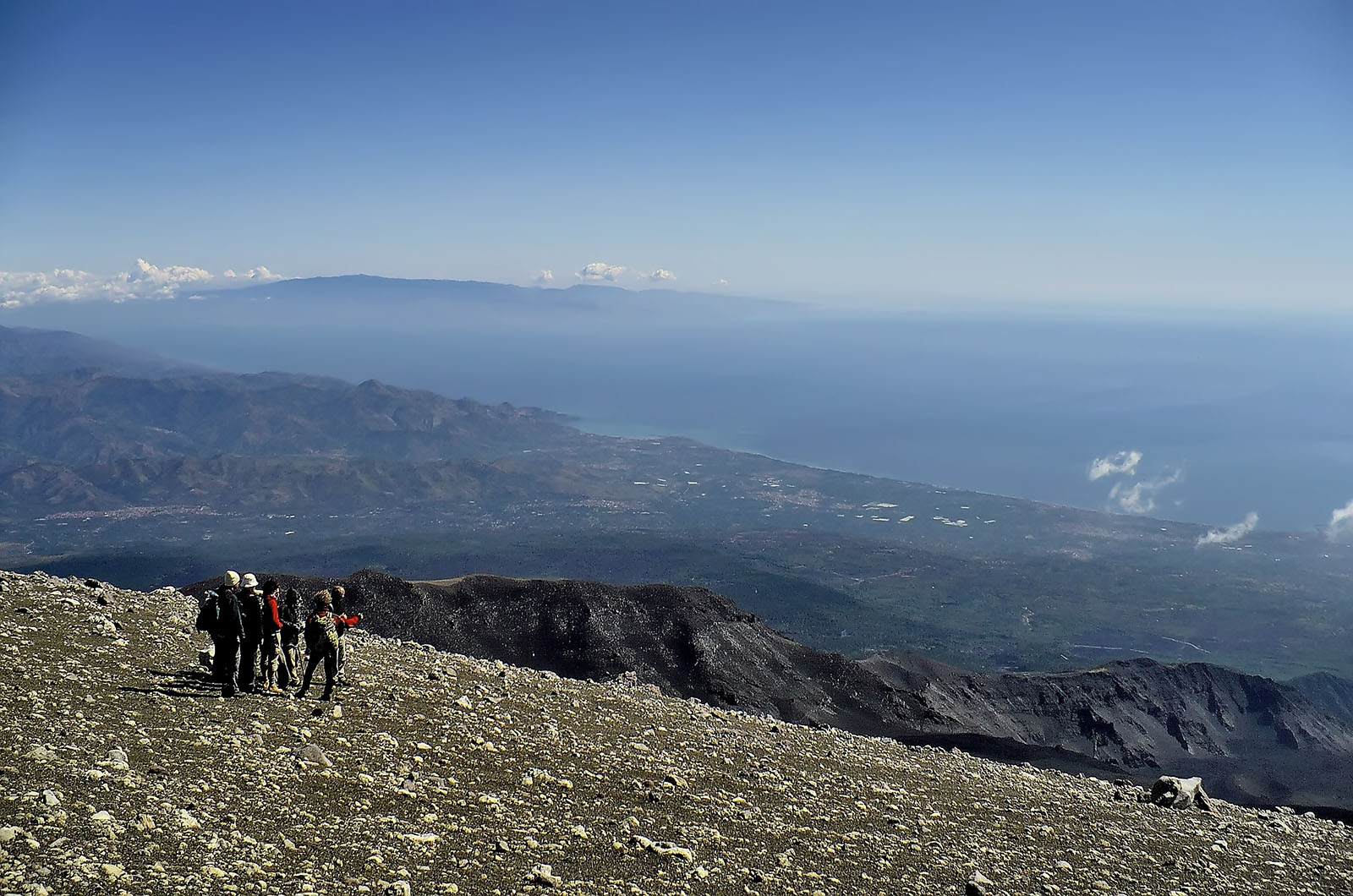
Panorama dal Belvedere In fact, the viewpoint overlooks the magnificent Valle del Bove, a vast depression 5-6 kilometres wide and long. However, it is not only a “pretty sight” because of the Valle del Bove.
From here you have one of the best views from a medium distance of the summit craters, and therefore of all the recent eruptions from the eruptive phase of the Mongibello Recente, which began around 15,000 years ago.
The summit craters are characterised by a perennial plume of gas, making Etna one of the volcanoes that emit the most gas into the atmosphere anywhere in the world. In the viewpoint area it is also possible to admire a very rare structure in the world of volcanology, a “ pit crater .
This very wide and circular depression is easily recognised, traditionally named and mapped as “La Cisternazza”. The viewpoint area appears to be dominated by a cone of ash, known as “Cratere Laghetto”, formed during the 2001 eruption.

The eruption of 1928 that destroyed the town of Mascali

Acireale and reconstruction after the 1693 earthquake

The “notches” of snow

The senses tell The Etna viewpoint

A fauna context yet to be discovered

The Grand Tour in Sicily

The Elliptical, the first great volcano of Etna

Val Calanna, the first step towards a single large volcanic structure

The Etna viewpoint

Acireale and its “timpe”

The senses tell Acireale

The Jaci river

Etna: a marvellous group of microclimates and vegetation

Valle del Leone and the Elliptical

Empedocles and his passion for Etna

Malavoglia

The senses tell The Summit craters

The senses tell Val Calanna

Torre del Filosofo: at the base of the summit craters (2950 metres)

The senses tell The Red Mountains

Lachea Island and the Aci Trezza Stacks

The earthquake that changed the geography of eastern Sicily in 1693

Etna, wine terroir of excellence

The senses tell Torre del Filosofo

Etna, the living mountain

The continuous evolution of the Etna summit craters

Summit crater activity between 2011 and 2019

Humankind and the volcano: how should we behave? Volcanic risk

The senses tell Valle del Leone

The first Etnean volcanic events between Aci Castello and Aci Trezza

The Red Mountains and the destructive eruption of 1669

The different names of the “Muntagna”

The 1669 eruption in Catania

The senses tell Acicastello and Acitrezza

The fault system of the “Timpe” of Acireale

Etna, an ever-changing natural laboratory

An ever-evolving volcano

The 2001 eruption of Mount Etna, where the approach to volcanoes changed

Why did Etna form in that specific geographical position?

Volcanic monitoring and eruption forecasting